How Close to Failure Should You Train for Muscle Growth?
Train most hypertrophy sets at 0-3 RIR, strength work further out. The science on proximity to failure, effective reps, and why your RIR estimate is off.
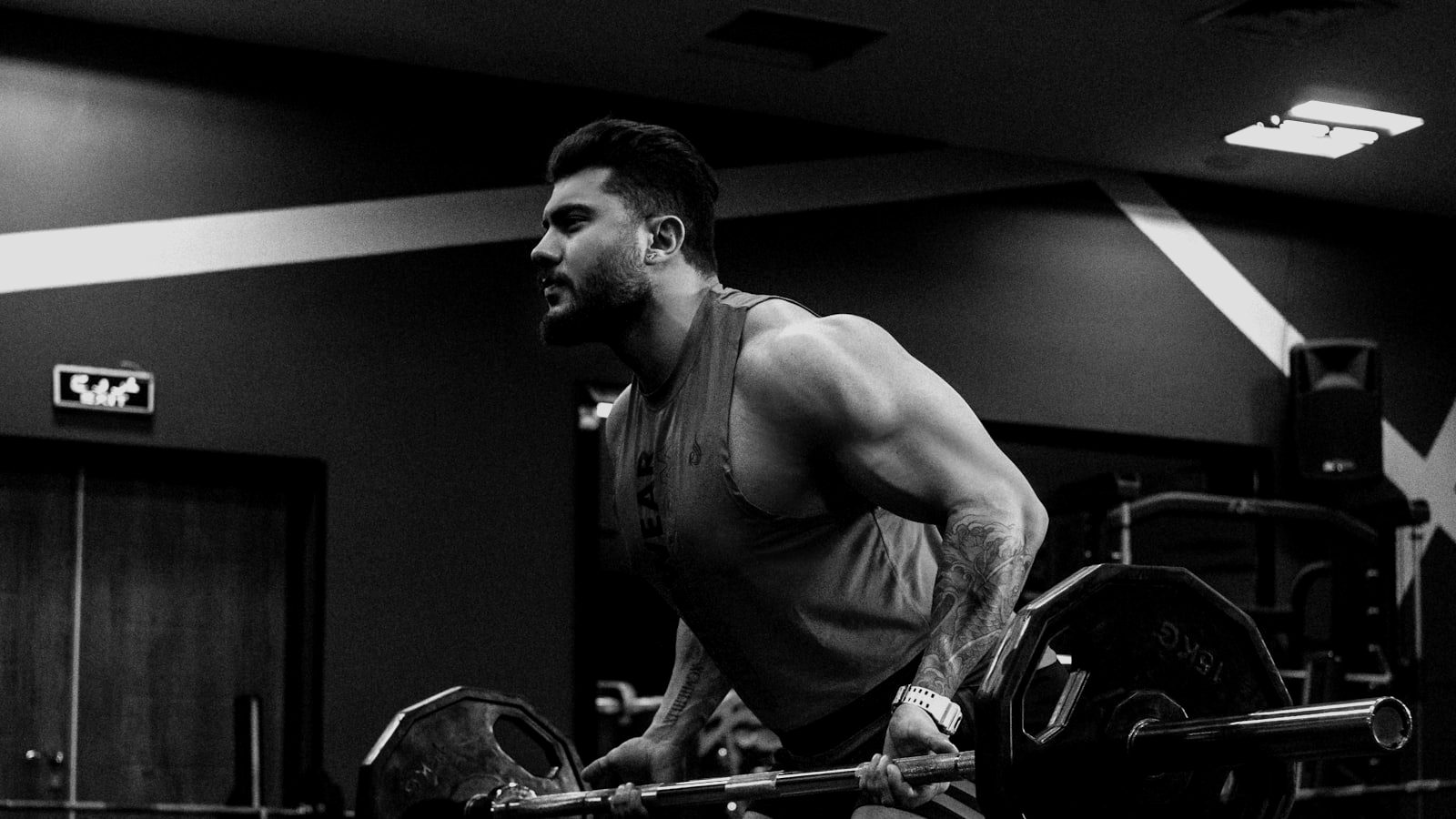 Riven · Training
For muscle growth, take most working sets to 0-3 reps in reserve (RIR) — meaning you stop when you've got roughly 0 to 3 reps left before form breaks or the bar stalls. How close to failure you should train depends on your goal: get close to failure for size, but for pure strength you can comfortably stay 2-4+ reps short, because heavy load — not proximity to failure — drives strength. The catch nobody tells you: most lifters are terrible at judging how close to failure they actually are.
I've coached people who swore they hit "2 RIR" and then cranked out six more reps when I called their bluff. That gap is the whole problem. Let's break it down.
Reps in reserve (RIR) in lifting is the number of additional reps you could have completed before reaching momentary muscle failure during a set. Two RIR means two reps left in the tank. Failure itself is the point where you physically cannot complete another rep with good form.
This is exactly the blind spot Riven was built for. Riven is an iOS + Apple Watch app that reads how much your reps slow down across a set — the validated signature of approaching failure — and gives you a per-set proximity score from the wrist alone. No camera, no barbell clip. More on that below, because the measurement problem is the real story here.
How close to failure should you train?
For hypertrophy, train most sets to 0-3 RIR, with the bulk of your serious working sets landing around 1-2 RIR. The dose-response research is fairly consistent: muscle growth is roughly maintained anywhere from 0 up to about 4-5 RIR when total volume is equated, then drops off once you're stopping sets more than 4-5 reps short of failure. A 2024 series of meta-regressions by Robinson and colleagues found that hypertrophy improves as sets get closer to failure — the slope pointed clearly in that direction, with a confidence interval excluding zero.
But "closer is better" is not "failure is mandatory." A 2022/2023 meta-analysis by Refalo et al. pooling 15 studies found only small, mostly non-significant advantages for training right to failure: momentary failure versus stopping short gave an effect size of just 0.12 (p = 0.343). Small. So you don't need to grind every set into the ground. You need to land in the productive zone — and reliably.
How close to failure for hypertrophy vs strength?
This is the most useful, least-discussed distinction in the whole conversation: proximity to failure matters for size, but not much for strength. For hypertrophy, train near failure (0-3 RIR). For strength, load matters more than proximity — you can train your heavy 3-5RM work at 2-4 RIR and gain just as well, because strength is driven by lifting heavy and practicing the movement, not by chasing the burn.
The same Robinson meta-regression that showed a hypertrophy benefit from getting close to failure found that strength gains were similar across a wide range of RIR — the slope's confidence interval contained zero. Ruple et al. (2023) backs this up directly: trained adults running 0-1 RIR versus 4-6 RIR for six weeks made similar squat, bench, and deadlift 1RM gains and similar quad growth — though the near-failure group showed distinct motor-unit firing-rate adaptations. So "same hypertrophy" didn't mean "identical adaptations," a nuance most blogs flatten.
What this means in a real program: you can run heavy compound strength work several reps shy of failure to protect your technique and your nervous system, then push your accessory hypertrophy work much closer — 0-2 RIR on a cable curl or leg extension where the risk is low. Different goals, different RIR targets, same session.
| Goal | RIR target | Why |
|---|---|---|
| Hypertrophy (most sets) | 0-3 RIR | Growth scales with proximity to failure |
| Hypertrophy (final set, isolation) | 0-1 RIR / failure | Low-risk lift, squeeze extra stimulus |
| Strength (heavy compounds) | 2-4 RIR | Load drives strength, not proximity |
| Beginner, any compound | 1-3 RIR | Protect technique, build the pattern |
What are 'effective reps' and why proximity to failure matters
"Effective reps" (also called stimulating reps) is the idea that not every rep in a set contributes equally to growth — only the hard reps near the end, where you recruit your high-threshold motor units and the rep slows down, produce high muscle-fiber tension. That tension is the growth signal. Chris Beardsley's model puts full motor-unit recruitment at roughly 90% of max force — around a 5RM load — which is where the "last ~5 reps are the stimulating ones" heuristic comes from.
This is why proximity to failure matters at all. If you stop a 15-rep set at 7 RIR, you may have skipped most of your stimulating reps entirely. The early, easy reps were just fatigue accumulation getting you to the part that counts.
Now, be skeptical of the literal version. Greg Nuckols at Stronger By Science has argued the direct evidence for a fixed "exactly the last 5 reps" rule is weak — proximity and volume are entangled, and "5" is a recruitment-threshold estimate, not a law. I agree. Treat effective reps as a mental model for why ending sets too early bleeds stimulus, not as a rep-counting prescription. The takeaway survives either way: the back end of a hard set is where the growth lives.
Can you train too far from failure (junk volume)?
Yes. Sets stopped too far from failure become junk volume — they add fatigue and time without delivering the high-tension stimulating reps that drive growth. The practical cutoff from the dose-response work sits around 4-5 RIR: stay inside that and growth holds up (volume equated); drift past it — sets averaging more than ~5 reps short — and hypertrophy meaningfully drops off.
Here's the trap that catches even good lifters. Because reps-in-reserve is so often underestimated (more on that next), a lifter who thinks they're training at "3 RIR" may actually be at 6-7 RIR — squarely in junk-volume territory — while believing they're working hard. You can do 20 sets a week and under-stimulate every one of them if each set quietly stops 6 reps early. That's the worst-case scenario: maximum fatigue, minimum return. The fix isn't always more volume. Often it's pushing the intensity of effort on the sets you already do.
How to measure your proximity to failure
The honest answer: most people measure it badly. RIR self-estimation is systematically biased — and the bias runs in the dangerous direction. Steele et al. (2017), across 141 participants, found lifters underpredict their reps to failure: the least experienced were off by about 4-5 reps, and even lifters with over three years of training underpredicted by 1-2, with a standard error of measurement around 2.6-3.4 reps. So when someone says "2 RIR," they frequently had 4-6 reps left.
That's not a rounding error. That's the difference between the productive zone and junk volume.
There are three ways to do better than gut feel:
- RPE/RIR logging with honest cross-checks. Periodically take a set to true failure and compare it to your estimate. It recalibrates your internal gauge — Steele's data shows experience helps, but only if you actually test yourself.
- Velocity loss. This is the validated objective proxy. As a muscle fatigues, reps physically slow down. Refalo's analysis used velocity-loss thresholds (high >25% vs moderate 20-25%) as a stand-in for proximity to failure, and growth trended upward with higher velocity loss. A linear position transducer measures this on the bar — accurately, and for about $300.
- Wrist-based proximity sensing. This is where Riven fits. Riven reads rep-speed decay from the Apple Watch IMU and converts it into a 0-100 failure-proximity score per set, per muscle group, backed by heart-rate context. It's measuring the same construct — velocity loss — that researchers used to define proximity to failure.
Straight talk on accuracy, because this audience can smell a marketing claim: the wrist signal is a proxy. It reads roughly half the magnitude of a $300 barbell transducer at the same fatigue level, and it's nowhere near EMG or lab-grade precision. What it is: an objective, on-wrist read of effort that beats guessing. Given that "guessing" means most lifters mis-estimate by 4-6 reps, beating it is a meaningful bar to clear — and it's the calibration error even experienced lifters carry into the exact 1-2 RIR band where it matters most.
The bottom line
Train most hypertrophy sets at 1-2 RIR (0-3 is the workable range). Keep heavy strength work 2-4 RIR — load does that job. Avoid the two failure modes: undershooting (junk volume from stopping too early, usually because you underestimated your reps left) and overshooting (grinding every compound to failure and torching your recovery and weekly volume). The single biggest upgrade for most lifters isn't a new program — it's getting an honest read on how close to failure they actually train. If you want that read without buying a barbell sensor, Riven gives you a per-set proximity score from the watch you already wear.
FAQ
How close to failure should I train for muscle growth?
Take most working sets to 0-3 RIR, with serious sets landing around 1-2 RIR. Growth holds up across roughly 0-5 RIR when volume is equated, but drops off once you're stopping more than 4-5 reps short of failure.
Is training to failure necessary to build muscle?
No. Controlled comparisons show 1-2 RIR produces hypertrophy equivalent to failure when volume is matched, while failure adds fatigue cost. Save true failure for low-risk isolation work and final sets.
How close to failure should I train for strength vs hypertrophy?
For hypertrophy, get close — 0-3 RIR. For strength, proximity matters far less; you can train heavy 3-5RM work at 2-4 RIR because load and practice drive strength gains, not how near failure you get.
Can you train too far from failure?
Yes. Sets stopped more than ~4-5 reps short become junk volume — fatigue and time without the high-tension stimulating reps that drive growth. This often happens unknowingly because lifters underestimate their reps in reserve.
Why are my reps-in-reserve estimates probably wrong?
Research shows lifters chronically underestimate reps to failure — novices by 4-5 reps, even experienced lifters by 1-2. A self-reported "2 RIR" is often really 4-6, which silently under-stimulates growth.
Sources
- Robinson et al. (2024), Exploring the Dose-Response Relationship Between Estimated Resistance Training Proximity to Failure, Strength Gain, and Muscle Hypertrophy — https://sportrxiv.org/index.php/server/preprint/view/295
- Refalo et al. (2023), Influence of Resistance Training Proximity-to-Failure on Skeletal Muscle Hypertrophy: A Systematic Review with Meta-analysis, Sports Medicine — https://pmc.ncbi.nlm.nih.gov/articles/PMC9935748/
- Ruple et al. (2023), The effects of resistance training to near failure on strength, hypertrophy, and motor unit adaptations in previously trained adults — https://pmc.ncbi.nlm.nih.gov/articles/PMC10161210/
- Steele et al. (2017), Ability to predict repetitions to momentary failure is not perfectly accurate, though improves with resistance training experience — https://pmc.ncbi.nlm.nih.gov/articles/PMC5712461/
- Chris Beardsley, How many stimulating reps are there in each set to failure? — https://sandcresearch.medium.com/how-many-stimulating-reps-are-there-in-each-set-to-failure-9d179f594dd
- Greg Nuckols / Stronger By Science, The Evidence is Lacking for Effective Reps — https://www.strongerbyscience.com/effective-reps/